Launch offer — valid today only

📄 Digital book in PDF · read it on your phone or print it

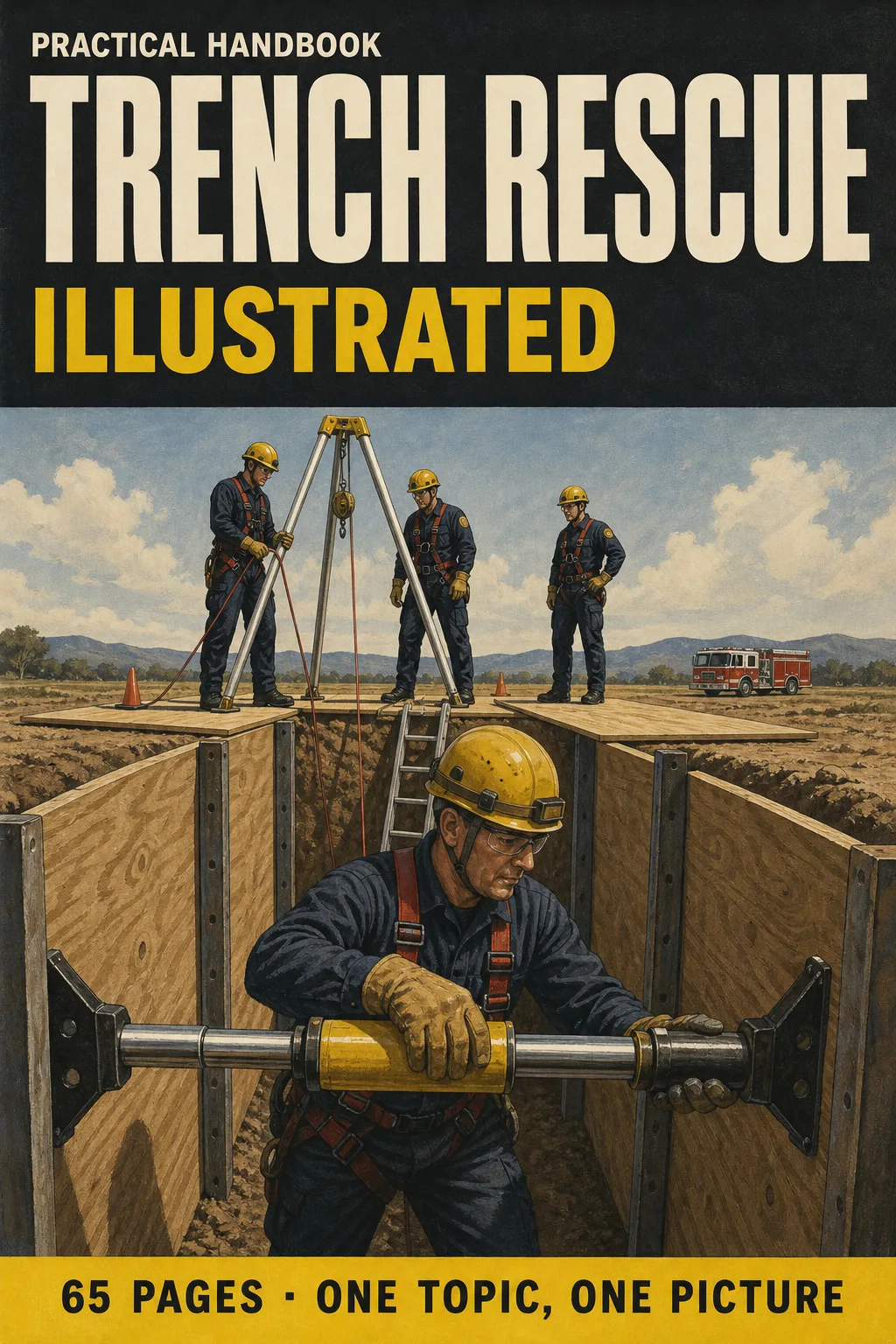
Trench Rescue Technician and OSHA Subpart P, Illustrated: Soil, Slopes and Shoring in the Same Order Every Time One Drawn Page Per Topic

Soil types, cave-in forces, size-up, air monitoring, sloping angles, protective systems, hydraulic and timber shoring, extrication. Every topic gets its own page: the drawing first, then what you need to remember. 65 illustrated pages.

START STUDYING THIS WAY

🔒 Secure checkout · PDF by email · 30-day guarantee

Every topic, its own pageEach soil rule and shoring step drawn, with the explanation beside it
65 illustrated pages65 illustrated pages in 8 parts, from how a trench fails to exam review
Up-to-date sourcesNFPA 1006 (trench chapter) and OSHA 29 CFR 1926 Subpart P
PDF by emailFormat

Look Inside the Book

Every page has one big drawing and a box with the numbers, rules or steps you need to know:

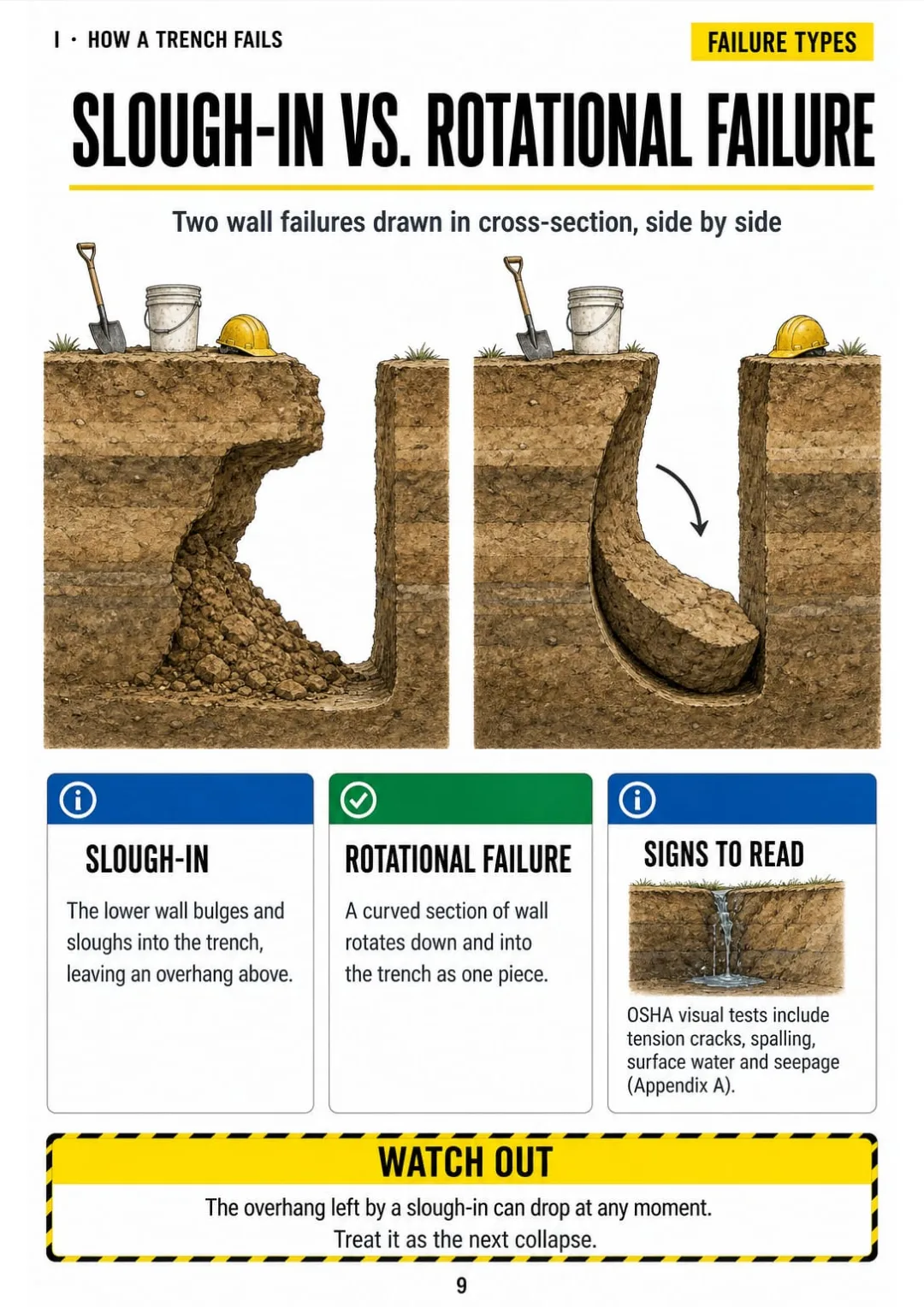
Slough-in leaves an overhang above; rotational failure rotates a curved section into the trench
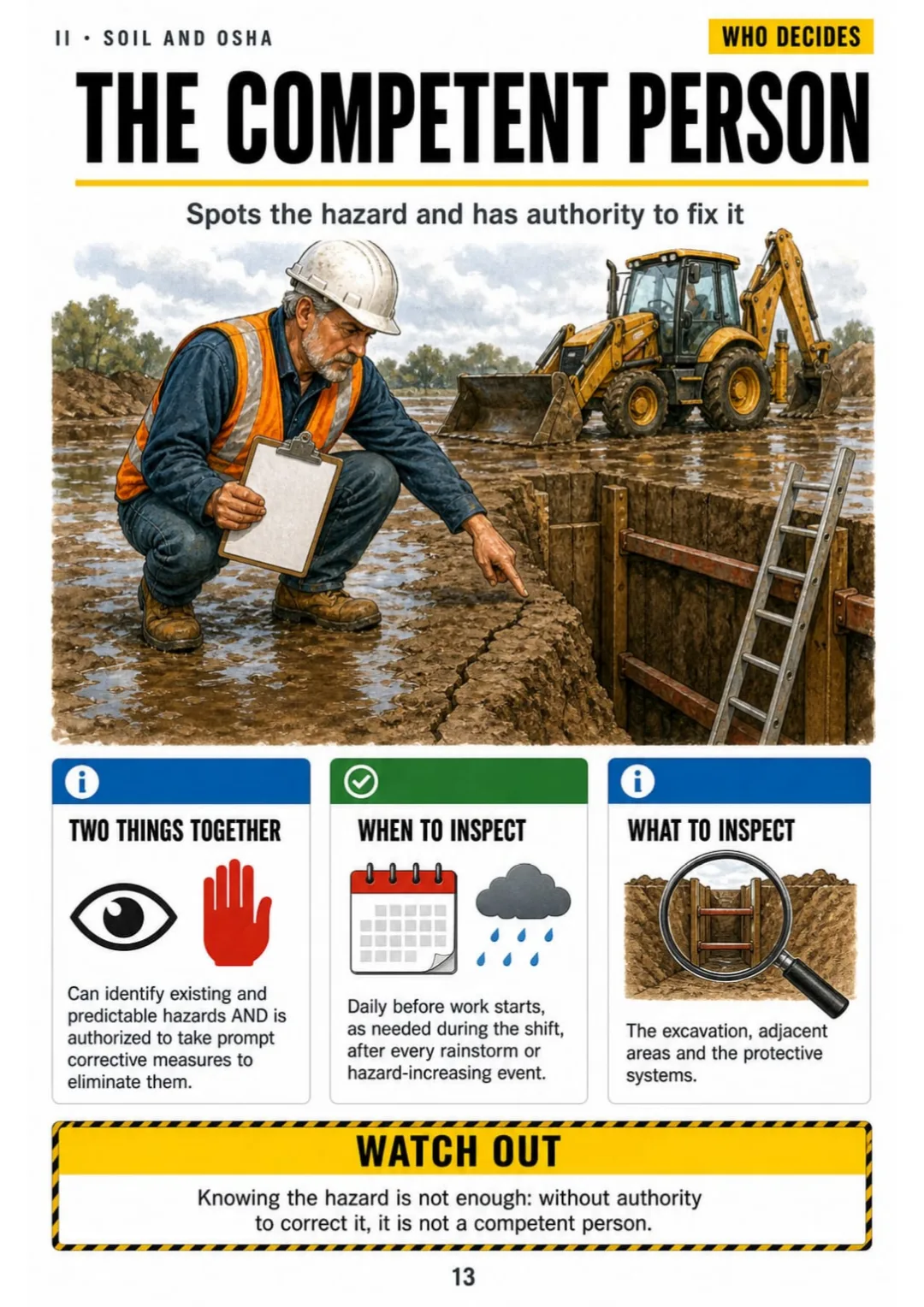
Competent person (1926.650): identifies hazards + authority to correct · inspects daily and after rain
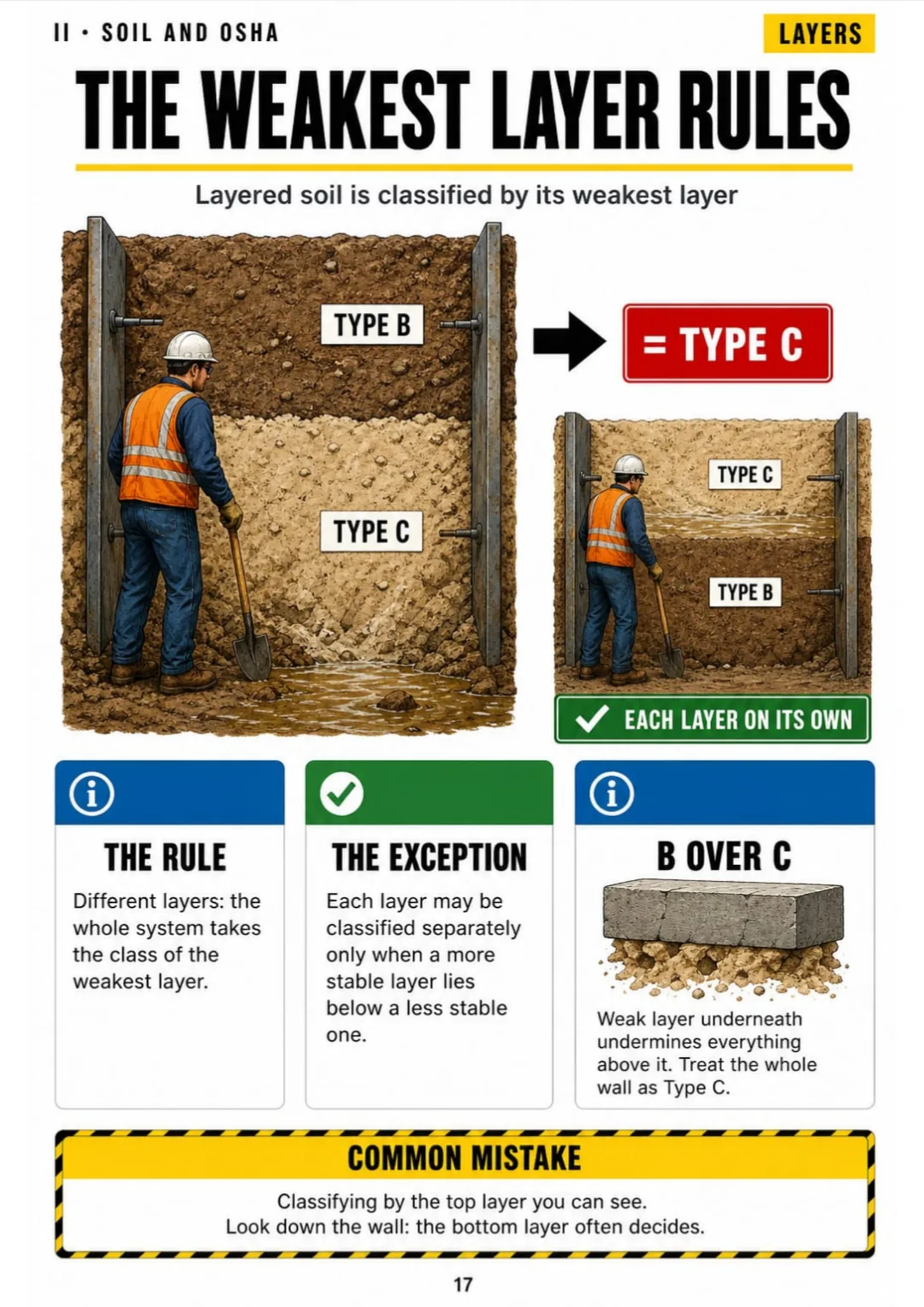
Layered soil = weakest layer · B over C is treated as C (Appendix A)
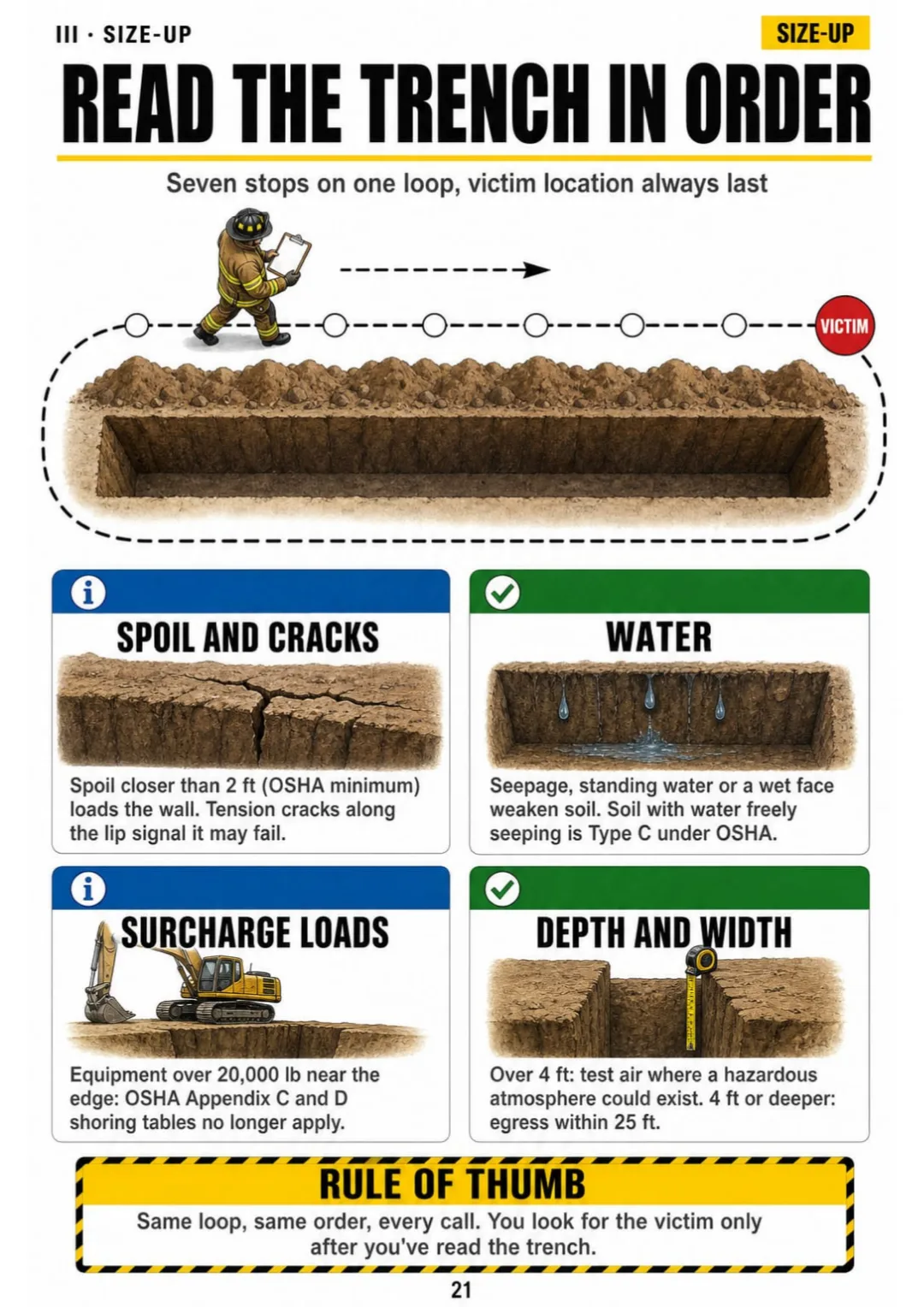
Spoil, cracks, water, vibration, loads, depth, victim: the size-up loop in order.
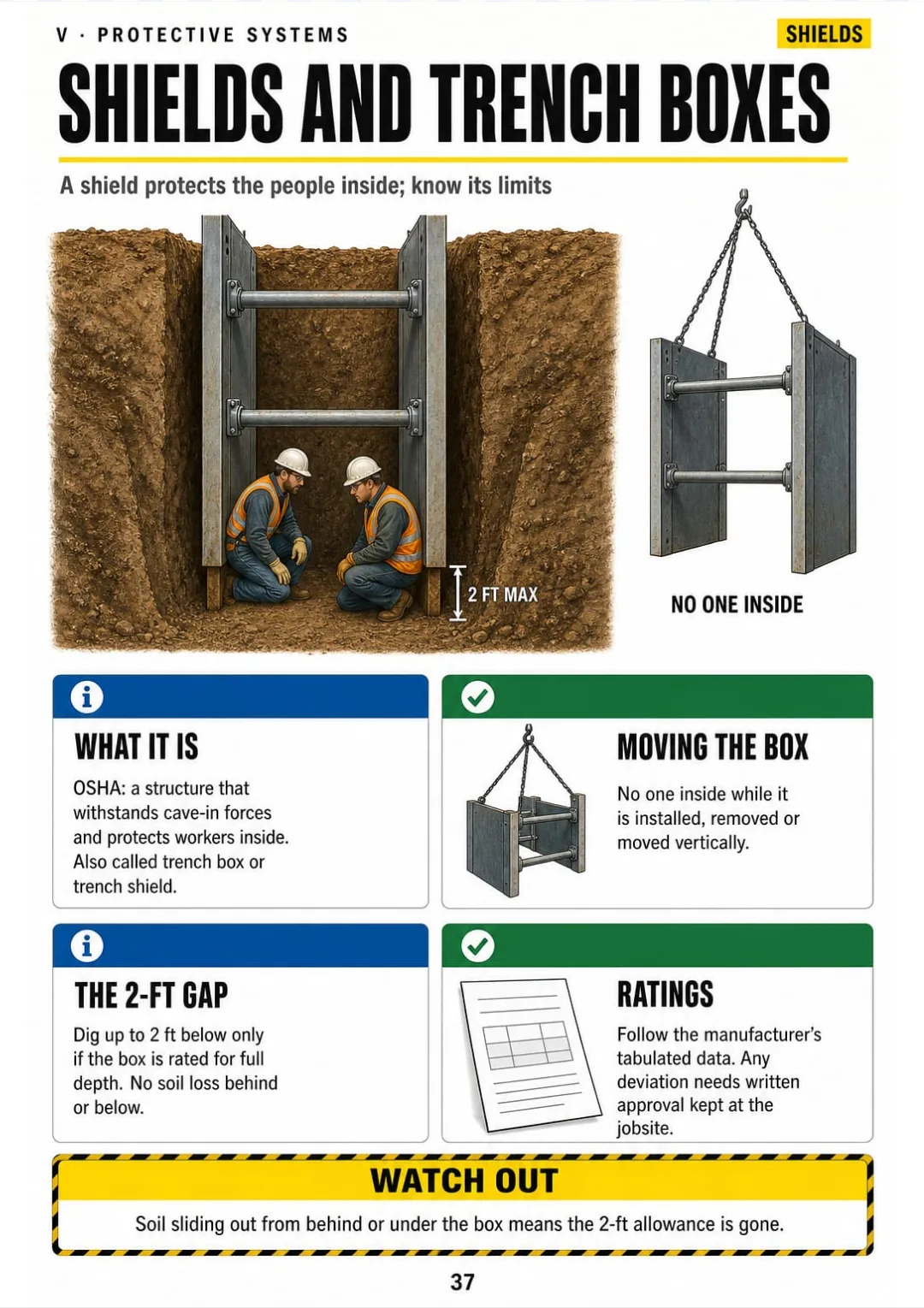
Trench boxes: no one inside while moved, and 2 ft max gap only when rated for full depth
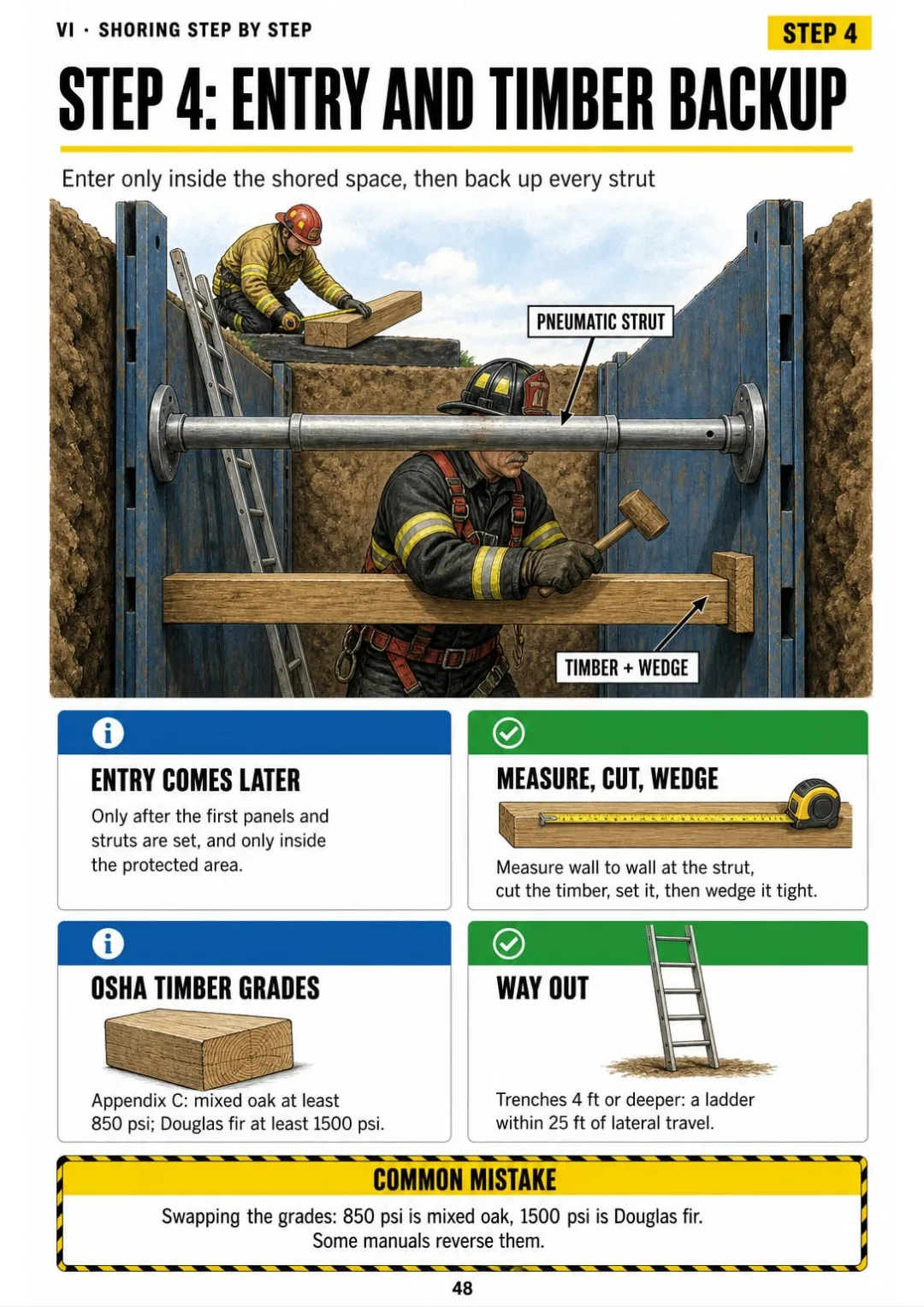
Entry after struts are set; each pneumatic strut backed up with measured, wedged timber
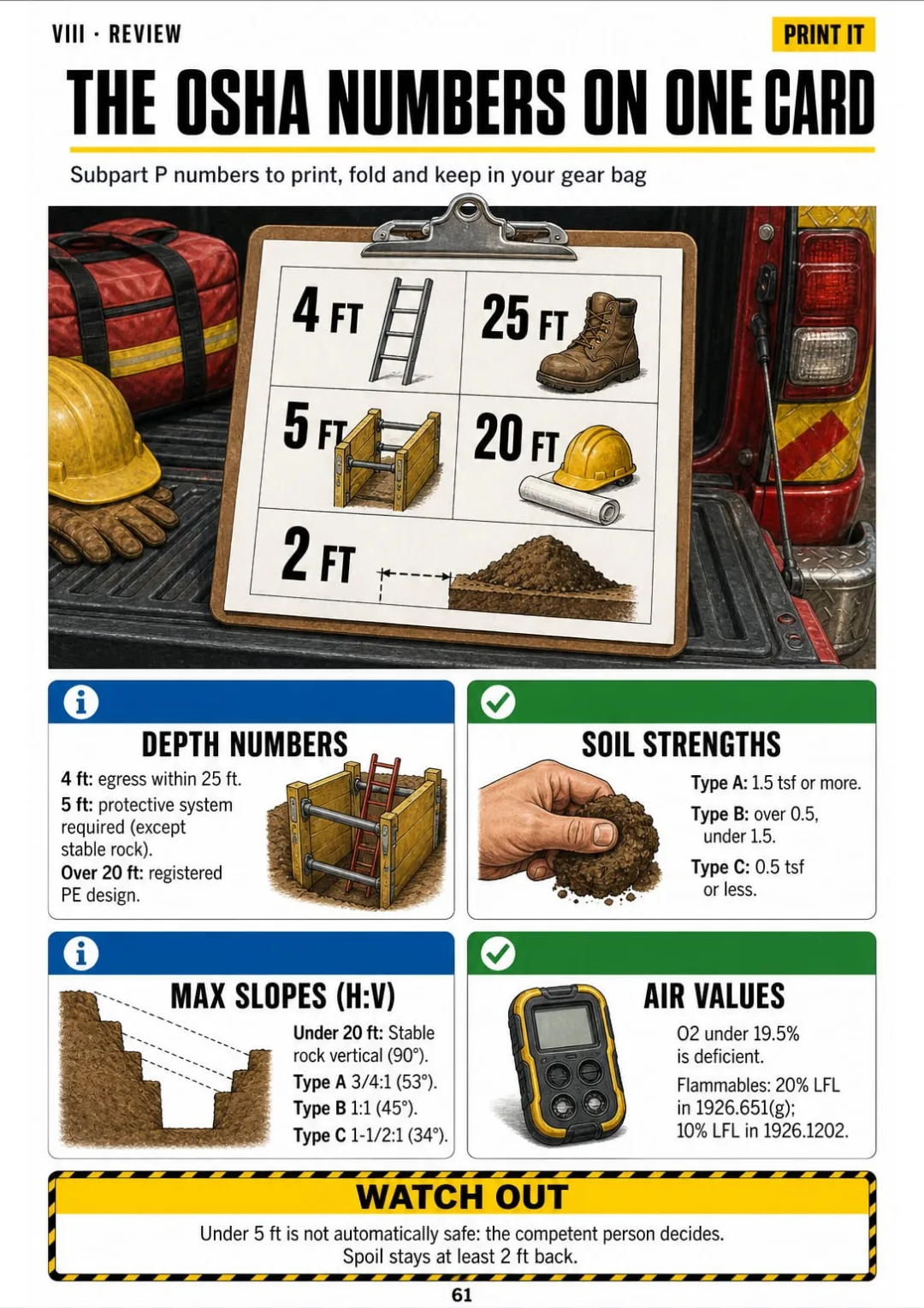
4 ft, 5 ft, 20 ft, 25 ft, 2 ft, soil strengths, slopes and air values on one card
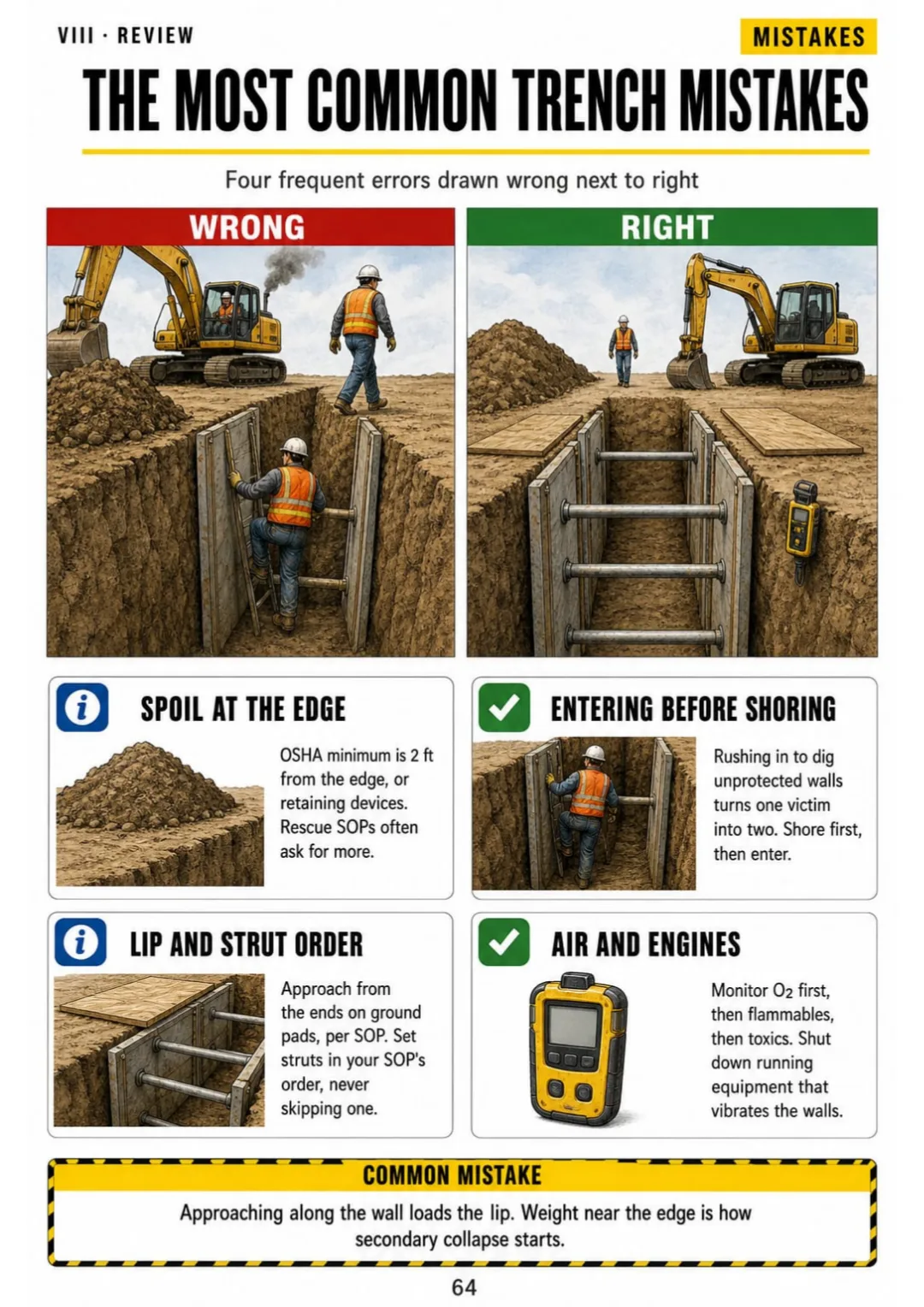
Spoil within 2 ft, entry before shoring, lip approach, strut order, no air, engines on

Swipe to see more →

These are real pages from the book. The table of contents is the full one: 8 parts and 61 topics.

The Problem Isn't You. It's How It Was Explained to You.

You're standing at the lip of a practice trench in Type C soil. The instructor asks what slope that wall would need, and your crew is waiting on your answer.

You did read it. But the manual gives it as a table, ratios in one column and soil types in another, buried between paragraphs. Ratios with no picture don't hold up under pressure.

Layered soil = weakest layer · B over C is treated as C (Appendix A)

In the book, that same topic is one page: four trench walls side by side. Rock straight up at 90°, Type A at 3/4:1, Type B at 1:1, Type C at 1½:1, each angle drawn so you see how far back the wall lays.

The same goes for layered soil, spoil pile distance, the shoring sequence and air monitoring. Each one has its own page.

You picture the page, and you answer without going back to the manual.

COMPARE FOR YOURSELF

Same Topic, Two Ways to Study It

THIS
  • The manual: line after line
  • Soil rules explained with words only
  • You show up to the practical still unsure
Soil and rock deposits shall be classified by a competent person prior to entry. In a layered system, the system shall be classified in accordance with its weakest layer. However, each layer may be classified individually where a more stable layer lies under a less stable layer. Accordingly, where a Type B soil overlies a Type C soil, the excavation face shall be treated as Type C, and the maximum allowable slope shall be determined in accordance with Appendix B of Subpart P.
FOR THIS
  • The layered soil rule in one drawing
  • The soil classes in one box
  • B over C: the whole wall drawn as Type C, at 1½:1
Competent person (1926.650): identifies hazards + authority to correct · inspects daily and after rain
CONTENTS

Take a Look at the 8 Parts and 61 Topics

How a trench fails, soil and the OSHA rules, size-up and scene control, air, water and utilities, protective systems and tools, shoring step by step, reaching the victim and exam review: 65 pages, all illustrated.

IHow a Trench Fails · pp. 5-11
  1. Why Trench Calls Are Different
  2. The Weight of Soil
  3. Spoil Pile Slide and Lip Failure
  4. Shear Wall Collapse
  5. Slough-In and Rotational Failure
  6. Secondary Collapse
  7. Trench Anatomy and Vocabulary
IISoil and the OSHA Rules · pp. 12-19
  1. OSHA Subpart P at a Glance
  2. The Competent Person
  3. The Four Soil Classes
  4. Visual Soil Tests
  5. Manual Soil Tests
  6. Layered Soil Rule
  7. Sloping Angles by Soil Type
  8. The Key OSHA Numbers
IIISize-Up and Scene Control · pp. 20-28
  1. Arrival: The First Five Minutes
  2. Reading the Trench in the Same Order
  3. Hot, Warm and Cold Zones
  4. Vibration and Traffic Control
  5. Ground Pads and Lip Protection
  6. Victim Information and Witness Questions
  7. Rapid Assessment: Rescue or Recovery
  8. ICS Roles on a Trench Call
  9. Resource Request Checklist
IVAir, Water and Utilities · pp. 29-34
  1. Call 811 and Locate Utilities
  2. Atmospheric Hazards in a Trench
  3. Air Monitoring Order
  4. Ventilation
  5. Water in the Trench
  6. Electrical and Gas Hazards
VProtective Systems and Tools · pp. 35-42
  1. Sloping, Benching, Shoring, Shielding
  2. Choosing a System: Appendix F
  3. Shields and Trench Boxes
  4. Panels, Uprights and Strongbacks
  5. Pneumatic and Hydraulic Struts
  6. Timber Struts and Wedges
  7. Wales
  8. The Shoring Tool Cache
VIShoring Step by Step · pp. 43-52
  1. The Shoring Sequence on One Page
  2. Step 1: Panels Lowered From the Lip
  3. Step 2: The First Strut
  4. Step 3: Middle and Bottom Struts
  5. Horizontal Strut Spacing
  6. Step 4: Entry and Timber Backup
  7. Building the Safe Zone
  8. Spot Shoring and Sheeting
  9. Intersecting Trenches: T, L and X
  10. Taking Down the Shoring
VIIReaching and Removing the Victim · pp. 53-59
  1. Uncovering the Head and Chest First
  2. Hand Digging and Buckets
  3. Vacuum Excavation
  4. Crush Injury Awareness
  5. Packaging the Victim
  6. Lifting Out: Rope and Ladder Options
  7. Accountability and Demobilization
VIIIReview and Exam Prep · pp. 60-65
  1. NFPA 1006: What the Trench JPRs Ask
  2. The OSHA Numbers on One Card
  3. Size-Up Checklist
  4. Shoring Sequence Checklist
  5. The Most Common Trench Mistakes
  6. Keeping the Skill When Calls Are Rare

One Page, One Topic, All Clear

Think of it this way:

Drill night. Your captain points at the trench and asks how you'd read it before anyone gets near the lip.

In the book you open the size-up page and see the loop drawn in order: spoil, cracks, water, vibration, loads, depth, victim.

Trench boxes: no one inside while moved, and 2 ft max gap only when rated for full depth

Same with soil classes, sloping angles, panels and strongbacks, the shoring sequence and air monitoring: each one on its own page.

Trench Rescue Illustrated is 8 parts and 61 topics, all drawn, with the OSHA numbers on one card, a size-up checklist, a shoring checklist and the most common mistakes at the end.

What you see drawn, you don't have to memorize.

What's Inside Trench Rescue Illustrated:

Ipp. 5-11

How a Trench Fails

Why trench calls are different, the weight of soil, spoil pile slides, shear wall, slough-in and rotational failure, secondary collapse and the vocabulary.

IIpp. 12-19

Soil and the OSHA Rules

Classify the soil and call the slope without going back to the table: Subpart P at a glance, the competent person, the four soil classes, visual and manual tests, the layered soil rule, sloping angles and the key numbers.

IIIpp. 20-28

Size-Up and Scene Control

The first five minutes, reading the trench in order, zones, vibration and traffic, ground pads, witness questions, rescue or recovery, ICS roles and resources.

IVpp. 29-34

Air, Water and Utilities

Calling 811, atmospheric hazards, the air monitoring order, ventilation, water in the trench and electrical and gas hazards.

Vpp. 35-42

Protective Systems and Tools

Sloping, benching, shoring and shielding, choosing a system with Appendix F, trench boxes, panels, struts, wedges, wales and the tool cache.

VIpp. 43-52

Shoring Step by Step

Set the shoring in the same order every time: the whole sequence on one page, then panels, first strut, middle and bottom struts, spacing, entry, the safe zone, spot shoring, T, L and X trenches and takedown.

VIIpp. 53-59

Reaching and Removing the Victim

Head and chest first, hand digging, vacuum excavation, crush injury awareness, packaging, rope and ladder lifts and demobilization.

VIIIpp. 60-65

Review and Exam Prep

What the NFPA 1006 trench JPRs ask, the OSHA numbers on one card, size-up and shoring checklists, common mistakes and keeping the skill.

At the end of the book: One card with the OSHA numbers, a one-page size-up checklist, a one-page shoring sequence checklist, and the most common trench mistakes.
Plus: 2 Free Books

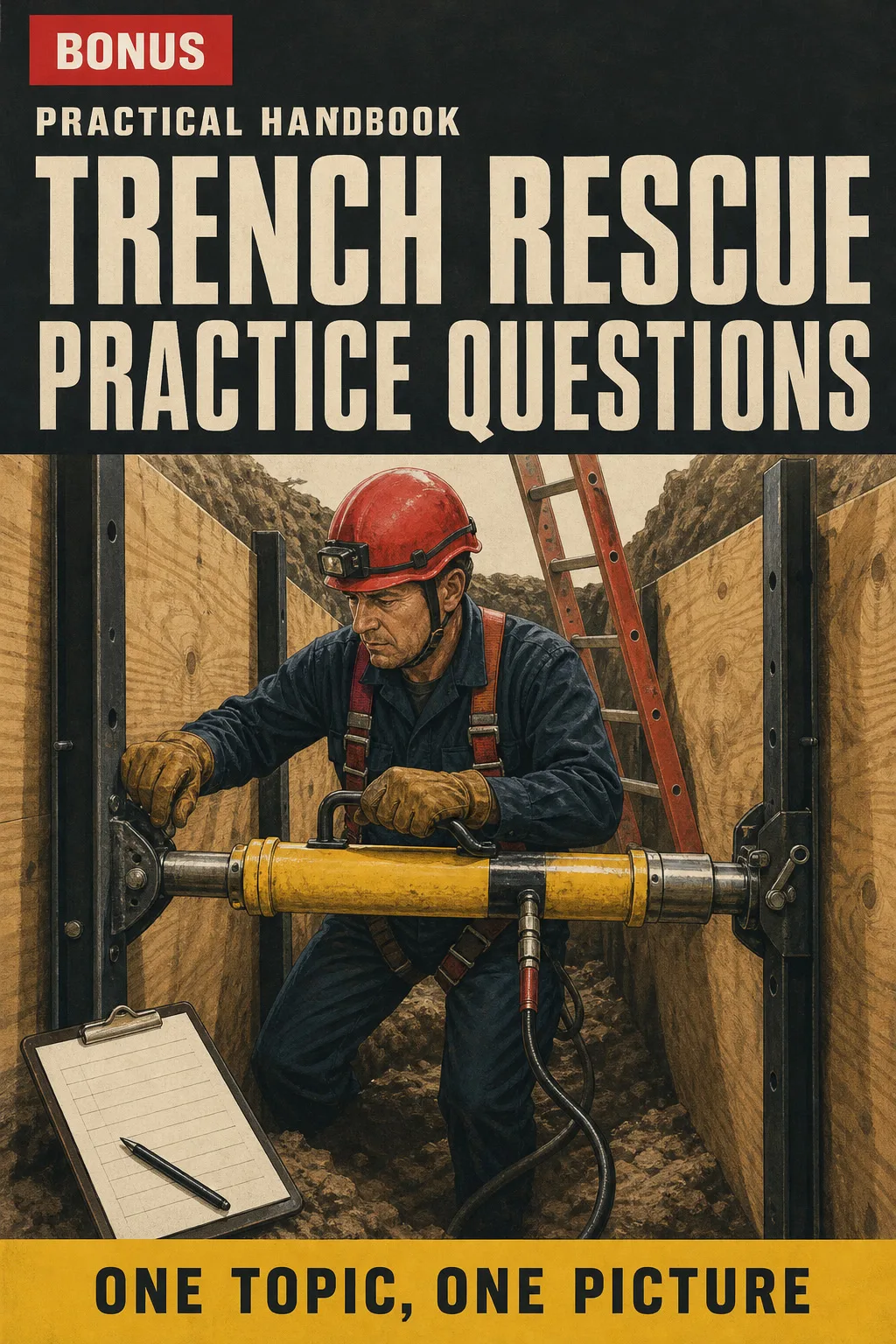
Trench Rescue Practice Questions

BONUS 1: «Trench Rescue Practice Questions»

Value on its own: US$ 17.90

Exam-style questions on soil, protective systems and shoring with the answer explained, so you find your weak spots before the written test.

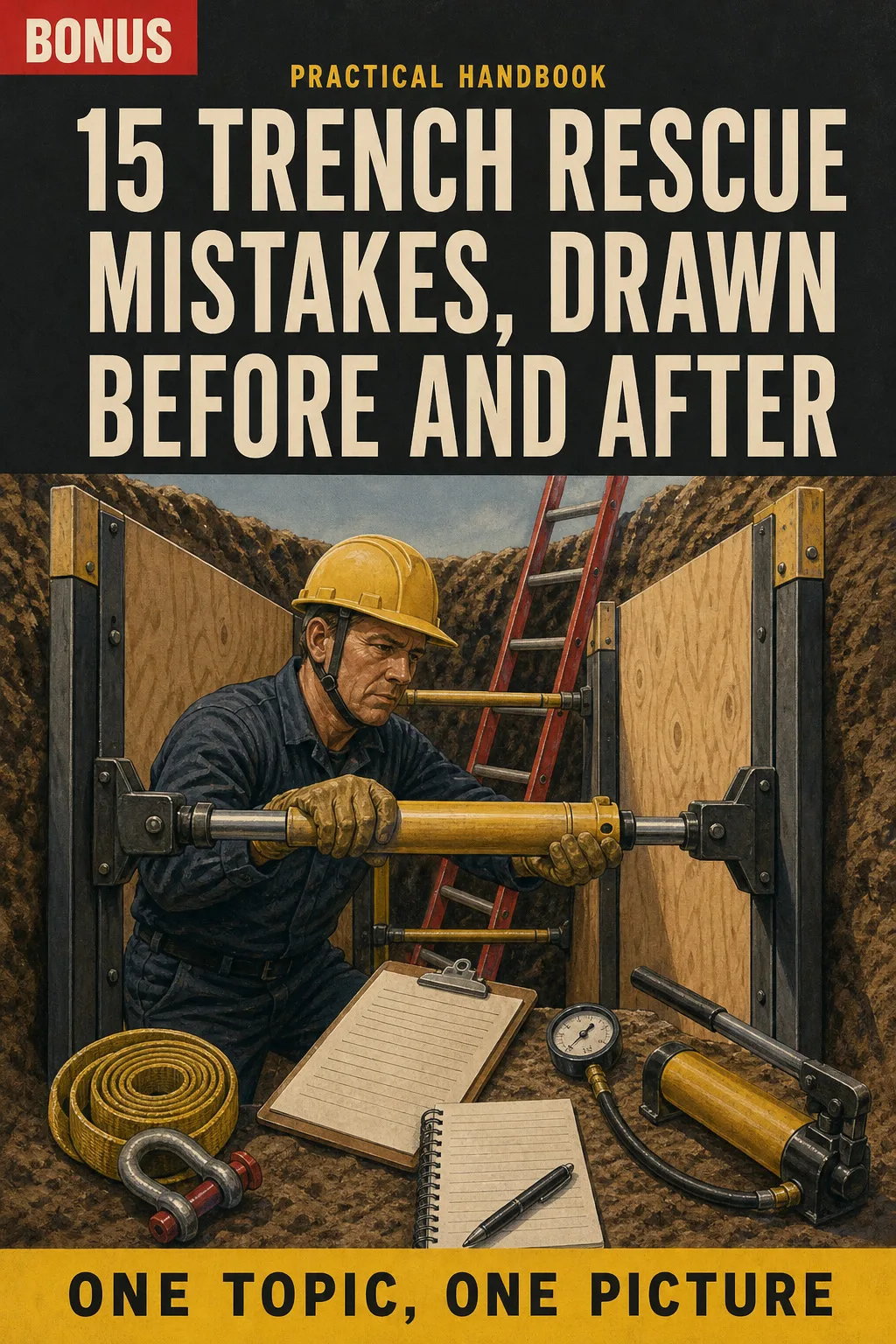
15 Trench Rescue Mistakes, Drawn Before and After

BONUS 2: «15 Trench Rescue Mistakes, Drawn Before and After»

Value on its own: US$ 14.90

The most common mistakes on the trench, from the spoil pile too close to the wrong strut order, each one drawn wrong and right so you can review them in minutes.

Trench Rescue Illustrated with 2 Free Books

  • Trench Rescue Illustrated: 65 illustrated pagesUS$ 63
  • BONUS 1: Trench Rescue Practice QuestionsUS$ 17.90
  • BONUS 2: 15 Trench Rescue Mistakes, Drawn Before and AfterUS$ 14.90
  • High-resolution PDF to printIncluded
Total value US$ 95.80
YOUR PRICE:
US$ 27
You save US$ 68.80
YES, I WANT TRENCH RESCUE ILLUSTRATED FOR US$ 27

📄 This is a digital PDF book sent to your email: nothing is printed or shipped.

Secure purchaseEncrypted payment30-day guarantee

PDF by email: We email you Trench Rescue Illustrated as a PDF, together with the two free books. It's a single payment: no installments, no extra charges.

Who This Book Is For

You're in the Trench Rescue Technician course

You're in the Trench Rescue Technician course

Every class topic has a drawn page, so you walk into each session already knowing what the instructor is talking about.

Your written test and practical are coming up

Your written test and practical are coming up

You review the soil classes, slopes and shoring sequence in the same order, and print the checklists to go over before each practical.

You're already certified on the team

You're already certified on the team

Trench calls are rare. A few pages between calls keep the size-up loop and the strut order fresh.

Everything You Get Today

US$ 95.80US$ 27
YES, I WANT TRENCH RESCUE ILLUSTRATED FOR US$ 27

📄 This is a digital PDF book sent to your email: nothing is printed or shipped.

30DAYS
GUARANTEE

30-Day Guarantee

Try Trench Rescue Illustrated for 30 days, bonus books included.

We refund everything if the file won't open, if the book isn't what you see here, if you were charged twice or if the email doesn't arrive. Just email us.

You pay once. No subscriptions.

Frequently Asked Questions

Is it for me if I've been on the job for 20 years and just joined the technical rescue team?

Yes. It doesn't explain firefighting basics. It puts the trench topics in order, one drawn page each, so you can review fast whatever your experience.

Where does the content come from?

From the trench chapter of NFPA 1006 and OSHA 29 CFR 1926 Subpart P, including Appendices A to F. Each state sets its own certification requirements and the NFPA edition it certifies to, and some states run their own OSHA plan with extra rules. Check both with your Pro Board or IFSAC accredited agency before your written test.

Is this official material?

No. It's an independent study book. It isn't published or endorsed by NFPA, OSHA, Pro Board, IFSAC or any state agency, and it doesn't give you a certificate or continuing education hours. Your certification comes from your state's course, written test and practical.

Does it replace the course or hands-on training?

No. It's study and review material. It doesn't replace hands-on training with a certified instructor, your department's SOPs or your local EMS protocols.

Are the practice questions the ones on the exam?

No. They're written for this book, in the style of a written test, to help you find your weak spots. They aren't official exam questions.

When and how do I get it?

The book and the 2 bonus books come as PDFs by email, sent to the address you enter at checkout.

Do I have to pay every month?

No. It's a one-time payment.

Can I get it on paper?

It's a PDF, and you can print it. The checklists and the OSHA numbers card are laid out to print and bring to drill night.

How does the refund work?

You have 30 days. We refund everything if the file won't open, if the book isn't what you see on this page, if you were charged twice or if the email doesn't arrive: just email us.

Before You Close This Page

No more rereading without it sticking.

Soil types and slopes: you see them drawn, and you've got them.

You show up to the practical knowing where everything goes.

Drawings make studying faster.

The book is right below.

One-time payment: US$ 27 · Guarantee: 30 days · PDF by email

YES, I WANT TRENCH RESCUE ILLUSTRATED FOR US$ 27

📄 This is a digital PDF book sent to your email: nothing is printed or shipped.